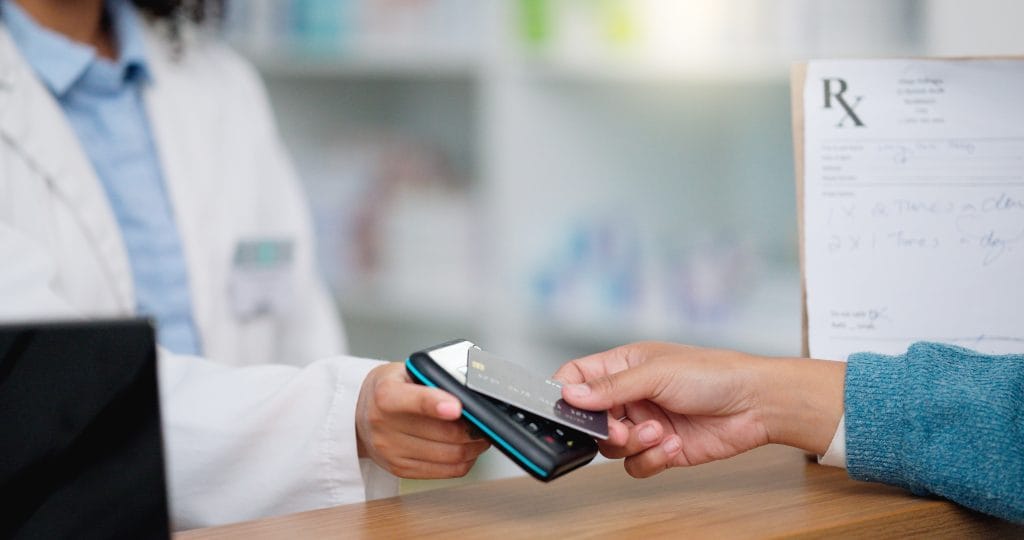
A prescription discount card is not insurance. It is a set of processing numbers that unlocks a pre-negotiated cash price at the pharmacy, and you pay that price in full at the counter. The pharmacy runs your prescription through the discount program instead of your health plan, and the negotiated rate replaces the pharmacy’s usual cash price.
That sounds simple, and at the register it often is. The complication is what you give up. A card can drop a common generic to a few dollars, but it can also cost more than a $10 copay, and the money you spend usually does not count toward your deductible.
What a prescription discount card actually is
Behind every free card sits a pharmacy benefit manager, or PBM, the middleman that negotiates drug prices and pharmacy payment rates. The card sponsor rents access to one of those negotiated rate schedules. When the pharmacy keys in the card’s RxBIN, RxPCN and group number, the claim goes to that PBM’s processor, which returns the contracted price you owe.
The pharmacy keeps the money you pay and forwards a small administrative fee to the PBM, which shares part of it with the card sponsor. That per-fill fee is why the card costs you nothing and why you get mailers offering more of them. Scale matters here: the three largest pharmacy benefit managers process close to 80% of prescriptions filled in the United States (US FTC).
The discounts are deepest on older generics, where the pharmacy’s list cash price is often far above what the drug costs to acquire. On brand-name drugs with no generic version, a card trims the sticker price but rarely turns a $700 fill into a bargain.
How to use a prescription discount card at the pharmacy
- Look up your exact drug, strength, quantity and form, then check prices by ZIP code. A 30-tablet price and a 90-tablet price are different deals.
- Note the pharmacy name and the price shown, including the quantity it covers.
- Hand the card, printout or phone screen to the technician before the prescription is filled and paid for.
- Ask for three numbers out loud: your insurance copay, the pharmacy’s plain cash price, and the discount card price.
- If the card wins, ask the pharmacy to reverse the insurance claim and rerun the fill on the card. This takes minutes and cannot be done after you walk out with the medication.
- Keep the receipt. It shows the amount paid and the processor used, which you will need if you ask your plan to credit the spending.
Quick tip: save the card numbers in your phone notes, because the pharmacy needs the digits, not the app.
Is a prescription card different than an insurance card?
Yes, and the difference is which benefit gets billed. Your medical card covers visits, labs, imaging and vaccines billed on the medical side. Your pharmacy card, sometimes called a pharmacy benefits card, covers drugs you pick up at the counter.
Many plans print both sets of numbers on one card. Others carve the drug benefit out to a separate PBM and mail a second card. A pharmacy card usually shows:
- RxBIN, a six-digit bank identification number that routes the claim
- RxPCN, a processor control number that points to the right plan setup
- RxGRP, your employer or plan group code
- Your member ID and, often, a pharmacy help desk phone number
If you need a pharmacy card and do not have one, it comes from your plan, not from a store. Call the member services number, sign in to the member portal, or ask your employer’s benefits contact. Medicare drug plans and standalone Part D plans issue their own cards. A discount card carries the same style of numbers, which is exactly why cashiers sometimes mistake one for coverage. It is not coverage: there is no premium, no network appeal rights and no annual out-of-pocket limit.
Do prescription discount cards work with insurance?
Not on the same prescription. Each fill is processed either through your plan or through the discount program, so you cannot stack a card on top of a copay to shave it further.
You can still mix and match. Fill your generic blood pressure tablet on the card, then run your inhaler through your plan in the same visit. Nothing stops you from switching cards or switching back next month, and the pharmacy can price both ways before it finalizes anything.
Two mechanics catch people out. First, spending on a card usually does not apply to your deductible or your out-of-pocket maximum, because your insurer never sees the claim. Some plans will credit it if you submit the receipt, so ask before you assume. Second, using a card does not remove prior authorization or step therapy rules; it sidesteps them, which can be a relief for a cheap generic and a problem for a drug you will need covered later.
Prescription discount card vs insurance: which is cheaper for you
The prescription discount card vs insurance question comes down to one comparison at the counter, repeated for each drug. Copay structures, deductible status and the drug’s tier all move the answer.
| Your situation | Usually cheaper | Why |
|---|---|---|
| Common generic on a store’s low-cost generic list | Cash or card | The flat program price often lands below any copay |
| Tier 1 generic with a $0 to $10 copay | Insurance | Your plan already absorbed most of the cost |
| Deductible not yet met on a high-deductible plan | Depends | Card may cost less today, but plan spending counts toward the deductible |
| Brand drug with coinsurance | Insurance | A percentage of a negotiated rate usually beats a discounted list price |
| Specialty or biologic medication | Insurance | Cards rarely touch prices in the thousands |
| No drug coverage at all | Card | It is the only negotiated rate you can reach |
| Drug excluded from your formulary | Card | An excluded drug is full price through the plan anyway |
Run your own numbers before the next refill, including what the plan route does to your deductible progress.
Prescription Discount Card vs. Insurance
| Discount Card | Insurance | |
|---|---|---|
| Common generic (no coverage) | Usually cheaper | N/A |
| Tier 1 generic ($0-$10 copay) | May cost more | Usually cheaper |
| Brand drug with coinsurance | Rarely competitive | Usually cheaper |
| Specialty/biologic | Rarely helpful | Usually cheaper |
| Drug excluded from formulary | Usually cheaper | Full price anyway |
| Deductible not yet met (HDHP) | May cost less today | Counts toward deductible |
Insurance or cash pay, which is cheaper
Going through insurance is not automatically cheaper. Deductibles, copays and prior authorisation can make a cash-pay programme the better deal.
Coverage is never something a programme can promise: plans decide, prior authorisation is routine for GLP-1 medicines, and denials are common. Confirm with your own plan before choosing.
Should you use your insurance or GoodRx?
Use whichever is lower for that specific drug at that specific pharmacy, and check again when anything changes. GoodRx, SingleCare, Optum Perks and RxSaver each sit on different PBM contracts, so the same tablet can carry three different prices in one town.
Things that flip the answer:
- A switch from brand to generic, or a change in strength or quantity
- A new plan year, a new formulary or a reset deductible
- Moving from a 30-day to a 90-day fill
- Changing pharmacies, since chain and independent contracts differ
- Reaching your out-of-pocket maximum, after which insurance covers the rest
One habit does most of the work: price the drug at two or three pharmacies, then ask the pharmacist to confirm at the counter.
What are the drawbacks of using a prescription discount card?
- No deductible credit. Card spending usually does not count toward your deductible or out-of-pocket maximum, so a cheap year today can mean a slower path to plan protection later.
- Price volatility. The quoted price is a contracted rate, not a guarantee. It can differ next month or at a different location of the same chain.
- Pharmacy pushback. Some independents lose money on certain card rates and may decline them or steer you to their own cash price.
- No appeal rights. There is no coverage determination, no formulary exception and no grievance process.
- Weak on high-cost drugs. Specialty medications, biologics and many brands stay unaffordable on a card.
- Data sharing. Discount programs collect prescription and pharmacy data, and business models often involve advertising or analytics.
- Paid memberships. A few cards charge a monthly fee. That only makes sense if the savings on your specific medications clearly exceed the fee.
- Medicare timing. Cash payments do not count toward your Part D true out-of-pocket total, which delays the annual cap.
Are prescription discount cards legitimate?
The mainstream ones are legitimate and legal. They are commercial products, not charity, and they work exactly as advertised: access to a negotiated cash price, funded by a per-fill administrative fee. Pharmacies process millions of these claims, and the numbers on the card are standard industry routing codes.
Judge a card by three things: it should be free or clearly priced, it should not ask for a Social Security number or bank details to “activate” a discount, and it should never describe itself as insurance. Unsolicited mailers that look like plan documents deserve a second look. State health departments and nonprofits also issue free cards, and some counties run their own programs.
Discount cards, Medicare Part D and the math that changes
You cannot combine a discount card with Medicare on the same claim, but you can pay cash with a card instead of using your drug plan. For a $6 generic that never touches your plan spending, that can be a fine trade.
It gets riskier if you take expensive medications. Part D now includes an annual limit on what you pay out of pocket for covered drugs, and that limit is set in law and adjusts each year, per Medicare drug coverage rules (Medicare.gov). Only spending that runs through your plan counts toward that limit. Covered insulin is also capped at a set monthly amount per prescription under Part D, which is almost always better than a discount card price.
If your income is limited, the Extra Help program, formally the Part D Low-Income Subsidy, cuts premiums and copays far more than any card. Before you switch a long-term prescription to cash, work out the yearly difference rather than the monthly one.
What a year actually costs
Programmes quote a monthly headline. Add the medication, the labs and the renewal price and the real number is usually different.
Advertised prices change often and intro pricing rarely lasts. Ask what the renewal rate is before you commit to a plan.
Manufacturer savings programs versus discount cards
These are different products with different rules. A manufacturer copay card lowers your share of a brand drug when you already have commercial insurance. Most exclude anyone with Medicare, Medicaid, TRICARE or other federal coverage, because federal anti-kickback rules bar that combination.
Two plan designs blunt copay cards. Copay accumulator programs stop counting manufacturer help toward your deductible. Copay maximizer programs spread the manufacturer’s annual allowance across the year and set your cost equal to it. Either way, the assistance runs out and you feel it.
Patient assistance programs are the third route. Run by manufacturers or foundations, they supply drugs free or at low cost to people under set income thresholds, and they usually require a clinician form, proof of income and a renewal each year. Compared with all of that, a discount card is the fast option with the smallest ceiling on savings.
When flat cash pricing beats both
A growing set of sellers skips the discount layer and posts one price. Cost Plus Drugs publishes acquisition cost plus a markup and pharmacy fee. Amazon Pharmacy, Walmart, Kroger and other chains keep low-cost generic lists. Many telehealth services quote a flat monthly price that bundles the clinician visit, the medication and shipping, which is easier to compare than a copay plus a visit fee.
For newer drug classes, the spread between sellers can be wide for the same molecule. Semaglutide is a clear example: $99 to $499
Before you commit to any flat price, check what it includes: clinician follow-ups, dose changes, lab work, syringes or pen needles, and shipping. A cheap headline price with paid add-ons can end up costing more than a slightly higher all-in figure.
What to do before your next refill
Ask the pharmacy these questions while the prescription is still on the shelf:
Questions to Ask Before Every Refill
- What is my copay - flat or a percentage?
- What is the pharmacy's plain cash price with no card?
- What is the best discount card price you can run today?
- Is a 90-day fill cheaper per month than a 30-day fill?
- Is there an authorized generic or therapeutic alternative?
- Will my plan credit card spending toward my deductible?
- Can I pay with HSA or FSA funds?
- What is my copay, and is it a flat copay or a percentage?
- What is your cash price without any card?
- What is the best discount card price you can run today?
- Is a 90-day fill cheaper per month than a 30-day fill?
- Is there an authorized generic or a therapeutic alternative my clinician could consider?
Then handle the paperwork side. Ask your plan whether it will credit card spending toward your deductible, keep receipts either way, and check whether you can pay with HSA or FSA funds; prescription medicine is generally a qualified medical expense, and IRS Publication 502 sets out the rules. If your plan denies a drug you need, request a formulary exception rather than paying cash indefinitely.
Why it matters: the same prescription can carry three different prices in one pharmacy on one day, and only you can see all three.
Authoritative sources
- Federal Trade Commission report on pharmacy benefit managers
- Medicare Part D drug coverage rules
- HealthCare.gov definition of a deductible
This content is for general informational purposes only and is not a substitute for professional medical advice, diagnosis, or treatment. Always consult a qualified clinician or pharmacist about your situation, and seek urgent care or call your local emergency number for severe or worsening symptoms.
Frequently asked questions
What are the drawbacks of using a prescription discount card?
Card spending usually does not count toward your deductible or out-of-pocket maximum, because your insurer never sees the claim. Prices are contracted rates that can change between refills and between pharmacies. There are no appeal rights, no formulary exceptions and no annual spending limit. Savings are thin on brand and specialty drugs, and the programs collect prescription data as part of their business model.
Do prescription discount cards work with insurance?
Not on the same prescription. Each fill is billed either through your plan or through the discount program, so a card cannot reduce a copay further. You can use a card for one drug and your plan for another on the same trip, and the pharmacy can price both ways before finalizing the sale. If the card is cheaper, ask for the insurance claim to be reversed and rerun before you pay.
Is a prescription card different than an insurance card?
Yes. A medical insurance card bills visits, labs, imaging and medically billed vaccines. A pharmacy benefits card bills medications at the counter and shows routing details such as RxBIN, RxPCN and a group number. Some plans print both on one card, while others use a separate pharmacy benefit manager and issue a second card. A discount card uses the same style of numbers but provides no coverage.
Are prescription discount cards legitimate?
Mainstream cards are legitimate. They give you access to a cash price negotiated by a pharmacy benefit manager, and the sponsor earns a small administrative fee on each fill. Be cautious with any card that charges a fee without clear savings on your medications, asks for a Social Security number or bank details, or describes itself as insurance. Several states and nonprofits also offer free cards.
Should I use my insurance or GoodRx?
Use whichever is lower for that drug at that pharmacy, and recheck when the drug, quantity, pharmacy or plan year changes. Cards such as GoodRx, SingleCare and Optum Perks sit on different contracts, so prices differ. Insurance usually wins on brand drugs, specialty medications and low flat copays. Cards often win on older generics, excluded drugs and when you have no drug coverage. Remember that card spending typically will not advance your deductible.

